Achilles Tendon High Volume Injection
- Paul Williamson

- Jan 15, 2023
- 3 min read
Updated: Jan 19
Rehabilitation Guide

The high-volume injection for Achilles tendinopathy is designed to reduce pain by separating irritated tissues around the tendon and reducing pressure from inflamed structures. This can help improve comfort, allow better movement, and make the tendon more responsive to rehabilitation. A structured rehab plan is essential afterwards, as gradual loading helps the tendon heal, regain strength, and return to normal function.
Following your high volume injection we have created a guide to help you return to sport. Please feel free to use this outline in consultation with your own coach or physiotherapist to help you safely return back to your best.
Key Training Point: During all Gastrocnemius and Soleus raise exercises you will not be able to use the same weight at the top of the rep (inner-range when toes are pointed). Consider training this range separately with less weight, if essential to your sport. Evidence has indicated improved 'Tendon Strain' and 'Physiological adaptations' when training the mid to outer-range (heels down).
Rehabilitation Exercise Overview
Phase One - Recovery
This short recovery phase focuses on rest, reducing irritation, and allowing the tendon to settle, with only light daily activities and pain relief as needed.
Phase Two - Early Loading
Here we gently reintroduce load through simple yielding isometric exercises, helping calm pain and begin stimulating healthy tendon activity.
Phase Three - Progressive Strengthening
During this phase, we gradually increase tendon load using yielding and moderate overcoming isometrics, followed by early hypertrophy work for both the gastrocnemius and soleus, and the careful introduction of low-level plyometrics and return-to-run drills.
Phase Four - Heavy Slow Resistance
At this stage, we build stronger tendon capacity through heavy slow resistance training, while increasing overcoming isometrics and maintaining yielding isometrics to support both adaptation and ongoing pain control.
Phase Five - Performance & Sport Integration
The final phase focuses on restoring full power, speed, and functional movement patterns, preparing you to return safely and confidently to higher-level sport or demanding activities.
Outcome Measures
Strength Symmetry (Isometric)
Pain
Phase One - Recovery
This short recovery phase focuses on rest, reducing irritation, and allowing the tendon to settle, with only light daily activities and pain relief as needed.
Days 0-3
Complete rest & offload
Activities of Daily Living
Analgesia / Ice as required
Phase Two - Early Loading
Here we gently reintroduce load through simple yielding isometric exercises, helping calm pain and begin stimulating healthy tendon activity.
Days 4-7 (daily exercise)
Yielding Isometrics - pain<3/10

Additional Exercise Options
Bike - endurance based / low resistance
Walking as able
Upper strength as able
Lower strength - Open chain focus
Leg extension / Curls
Phase Three - Progressive Strengthening
During this phase, we gradually increase tendon load using yielding and moderate overcoming isometrics, followed by early hypertrophy work for both the gastrocnemius and soleus, and the careful introduction of low-level plyometrics and return-to-run drills.
Week 2-3 (3x per week)
Maintain Yielding isometrics 2 x per week for pain modulation if helpful on different days
Overcoming Isometrics - pain <3/10
Ramped effort (build-hold-release)
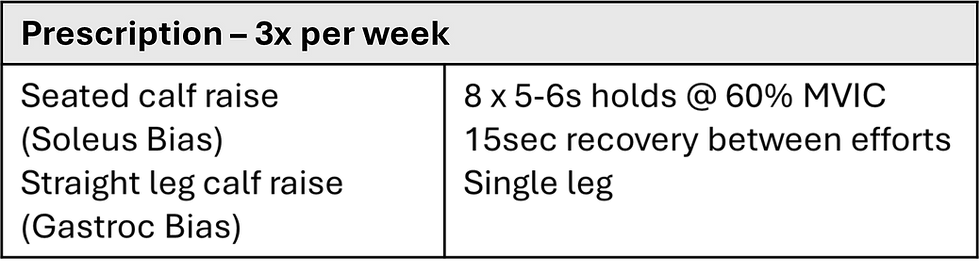
Week 4-5 (3x per week)
Introduction to Hypertrophy & load progression

Additional Exercise Options
Bike & walking as able
Strength as able
Week 3 - Initiate low level plyometrics
Week 3-4 Initiate return to run
Phase Four - Heavy Slow Resistance
At this stage, we build stronger tendon capacity through heavy slow resistance training, while increasing overcoming isometrics and maintaining yielding isometrics to support both adaptation and ongoing pain control.
Week 6-10 (2x per week)
Continued load progression
Maintain Yielding isometrics 2 x per week for pain modulation if helpful on different days
Overcoming Isometrics - pain <3/10
Ramped effort (build-hold-release)

Phase Five - Performance & Sport Integration
The final phase focuses on restoring full power, speed, and functional movement patterns, preparing you to return safely and confidently to higher-level sport or demanding activities.
Week 10+
Maintain 2 HSR per week
Maintain 2 overcoming isometrics sessions per week @95% MVIC
Progress Plyometrics to high intensity
Progress speed sessions
Incorporate multi-directional drills (cutting, sprinting, sport specific)
Objective criteria for progression:
strength symmetry >90% compared to contralateral side
VISA-A >80
Pain <2/10 during sports specific activities
Return to Run
This guide should be tailored specifically to your ability, rehab status & sport by your coach.
You may be able to initiate plyometrics & return to run at week 3 post injection
Pain <3/10
Complete the follow in sequence
48hrs recovery between running sessions
2-3 sessions per week

Running Drill Videos
Plyometric Exercises
Example Field Based Hi Intensity Running - Pitch Perimeters